
Tip pooling is when a restaurant combines the tips from a set period into one pot and splits it among eligible staff by a written method: equal shares, hours worked or role-weighted hours. For operators, the math is the easy part. Decide who is eligible, pick the formula and the pooling window, then make sure each person can trace their share back to the dollars collected. Paying it out is a separate step.
What is tip pooling, and how is it different from a tip-out?
A tip-out runs the other way: one person passes a set share of their own tips to colleagues, like a server tipping out the bar. Workplaces use these labels loosely, so your policy should describe how the money moves, not just name it.
| Term | How the money moves | Who sets the split | What to record |
|---|---|---|---|
| Tip pool | Collected first, divided second | Your written policy | Pot in equals total paid out |
| Tip-out | One worker shares part of their own tips with others | A house rule, such as a set percentage | Giver's and receivers' amounts match |
| Service charge | A compulsory charge the business adds to the bill | The business. Federally it is not a tip (DOL Fact Sheet #15) | Kept on its own line, apart from tips |
The finer distinctions are in tip pool vs tip share vs tip-out and service charge vs tip.
Who can participate, and which rules apply?
Settle eligibility before you touch weights or formulas. Under federal law the first question is whether you take a tip credit: paying tipped staff less than the full federal minimum wage in cash and counting their tips toward the difference (U.S. Department of Labor).
The federal baseline
| If you | Who may share the pool | Source |
|---|---|---|
| Take a tip credit | Only staff in occupations that customarily and regularly receive tips | DOL Fact Sheet #15 |
| Pay everyone the full federal minimum wage in cash, no tip credit | The pool may also include staff who don't customarily receive tips, subject to the other conditions | DOL Fact Sheet #15 |
| Have managers or supervisors on shift | They can't receive shares of the employees' pool under either option, but may keep tips for service they directly and solely provide | DOL Fact Sheet #15; same source |
The worked examples below use anonymous participants assumed to be eligible. They show the math, not permission to include a particular role.
State rules sit on top
States can add their own rules to the federal baseline. California's labor agency says a card tip must reach the employee in the full amount of the tip. The Texas Workforce Commission advises employers to put the tip-sharing policy in writing.
How do hours and points change the split?
Hold the pool and the roster still, change only the formula, and the differences show up fast. The owner worry behind most method changes is some version of "Does this punish high performers?" The honest answer depends on what your weights reward, so write that down before the shift.
Same $600, three formulas
- Equal split: pool ÷ number of people.
- Hours: pool × the person's eligible hours ÷ total eligible hours.
- Weighted hours (points): hours × role weight gives each person's units, then pool × their units ÷ total units.
| Person | Hours | Weight | Units | Equal | Hours split | Weighted hours |
|---|---|---|---|---|---|---|
| A | 6 | 2 | 12 | $200.00 | $300.00 | $360.00 |
| B | 4 | 1.5 | 6 | $200.00 | $200.00 | $180.00 |
| C | 2 | 1 | 2 | $200.00 | $100.00 | $60.00 |
| Total | 12 | n/a | 20 | $600.00 | $600.00 | $600.00 |
Read across row A: the same six hours earn $200, $300 or $360 depending on the formula. Every column still adds to $600. If yours doesn't, find the missing hours or the duplicated row before anyone gets paid. More worked detail: splitting tips by hours worked and the tip pool point system.
When someone changes roles mid-shift
Say B spends 2 hours at weight 1.5, then covers a weight-2 role for the last 2. Record B as two role-hour segments, run the split, then add B's segments back together for B's record. A plain average of the two weights only matches when both segments are the same length; segments stay right either way and show where the hours went.
B changes roles halfway through the shift
Pool total: 12 (A) + 7 (B) + 2 (C) = 21 units.
| Participant | Units | New share | Change |
|---|---|---|---|
| A | 12 | $342.86 | −$17.14 |
| B | 7 | $200.00 | +$20.00 |
| C | 2 | $57.14 | −$2.86 |
| Total | 21 | $600.00 | $0.00 |
Cents need a rule too. Calculate at full precision, round each share down to the cent, then hand out leftover cents one at a time, largest remainder first. Above, that leaves one cent, and it goes to A.
Should you pool by shift or across a longer period?
The pooling window is a separate choice from the formula. Combine two shifts into one pool and money moves between the people who worked them, even though the restaurant's total doesn't change. Below, all four people work 4 hours at the same weight, so only the window changes.
| Person | Shift | Hours | Shift pool (shared) | Pooled by shift | Pooled together | Difference |
|---|---|---|---|---|---|---|
| A | First | 4 | $180 pool | $90 | $150 | +$60 |
| B | First | 4 | Same $180 pool | $90 | $150 | +$60 |
| C | Second | 4 | $420 pool | $210 | $150 | −$60 |
| D | Second | 4 | Same $420 pool | $210 | $150 | −$60 |
| Total | Both | 16 | $180 + $420 = $600 | $600 | $600 | $0 |
The quiet first shift gains $60 each; the busy second shift gives up $60 each. Neither result is wrong. It's a choice about what the pool rewards, and the team should hear the reason before the first combined payout.
In an r/restaurant thread about moving to a weekly pool based on hours, one commenter described weekly pooling bringing stability and shared responsibility, alongside a workload imbalance, before their team switched to nightly pooling (source).
- Who gets more, and who gets less, under the proposed window?
- Do closing, opening or weekend patterns explain the gap?
- What is the change for: smoothing slow nights, rewarding certain shifts, or something else?
- Can a manager explain that reason in one sentence at pre-shift?
- What feedback or numbers would trigger a review?
What should staff be able to check at closeout?
A split can be correct and still feel wrong if nobody can trace it. One server described liking their pooled team but being unable to reconcile the biweekly check (source). Another described a restaurant keeping a shared book of the tips (source). Here is B's record from the original weighted-hours split, before the role change:
Participant B
- Pool
- Shift S-01, with its stated collection window
- Collected
- $480 card + $120 cash = $600.00
- Eligibility
- Reviewed policy version on file (not a legal ruling)
- Method
- Weighted hours (original $600 example, no role change)
- Your inputs
- 4 eligible hours × 1.5 = 6 units
- Pool units
- 20
- Your share
- $600 × 6 ÷ 20 = $180.00
- Adjustments
- None
- Payment status
- Allocated, submitted for payout, or paid
- Expected payout
- Your actual payout method and timing
- Questions
- Named owner and the channel to reach them
- Version
- Original (a revision shows its reason and time)
Shows this person's own inputs and the pool totals. No bank details, no one else's pay.
When someone disputes a number, fix it without losing the trail:
- Keep the original inputs. Don't overwrite them.
- Find the disputed segment, such as a missed clock-out or the wrong role.
- Have the named owner approve the fix.
- Recalculate every share in that pool, not just the disputed one.
- Confirm the pool total is unchanged, then issue revised records with the reason and time. If the total itself was wrong, document that separately.
Keep the record individual: each person sees their own inputs and the pool totals, not everyone's pay. Your tip pooling policy should name who owns corrections.
When is a spreadsheet enough, and when does software help?
A spreadsheet works when a small, steady team can see the inputs, the formula and the record. It strains as exceptions pile up.
| Signal | A spreadsheet holds up | Software earns its place |
|---|---|---|
| Roles and pools | One location, a few stable roles | Several pools or frequent role changes |
| Corrections | A missed clock-out now and then | Corrections most weeks |
| Rules | One window and method everywhere | Different rules by shift or location |
| Records | One person rebuilds the sheet each close | Staff questions need a record by date and location |
Ferry Tip Manager is built for the right-hand column. Pools can be set up by percentages, points, hours, role or job code, and shift or location (source), and you can calculate tips before changing how you pay them out (source).
Comparing tools that handle the split? See these TipHaus alternatives.
Ferry Tip Manager: the window and the record
For operators running several pools or correcting splits most weeks, two screens from Ferry's demo workspace match the two choices that cause the most questions. All data is synthetic.
Set the pooling window in one place. Tip Policies asks how tips should be pooled (by check, shift, day, weekly or bi-weekly) and whether cash tips go into tip sharing.
Ferry productFerry Tip Manager: Tip Policies
For the owner or manager deciding the window above: pick how often tips pool and whether cash joins the pool.
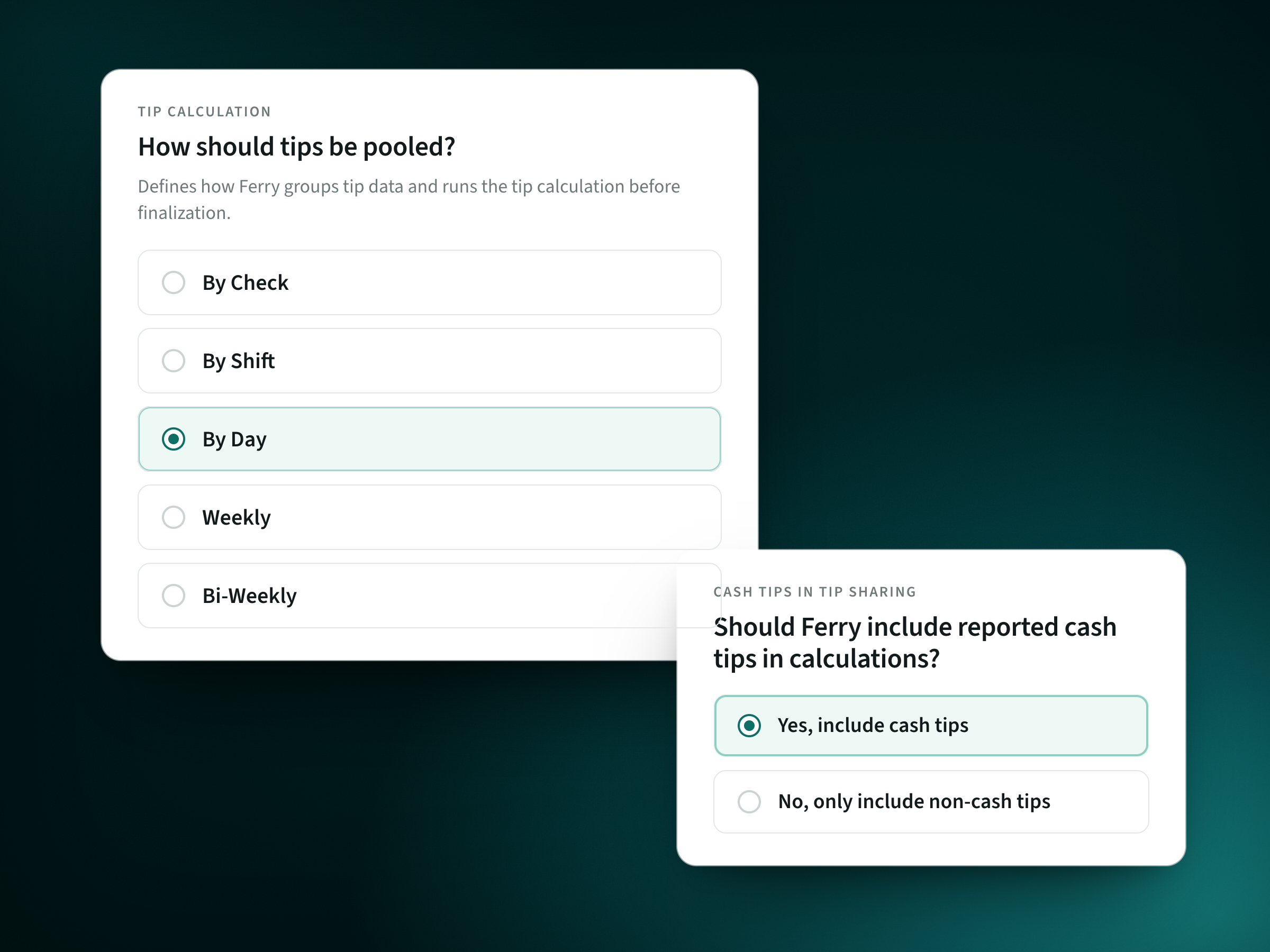
- Pool window: by check, shift, day or pay period
- Cash tips in or out of the pool
Show each person where their share came from. The Tip Calculation Summary report shows card and cash tips, each pool's contributions and each employee's distribution for one location and business date (source).
Ferry productFerry Tip Manager: Tip Calculation Summary
For the closing manager answering a share question: pool totals and every employee's distribution for one date.
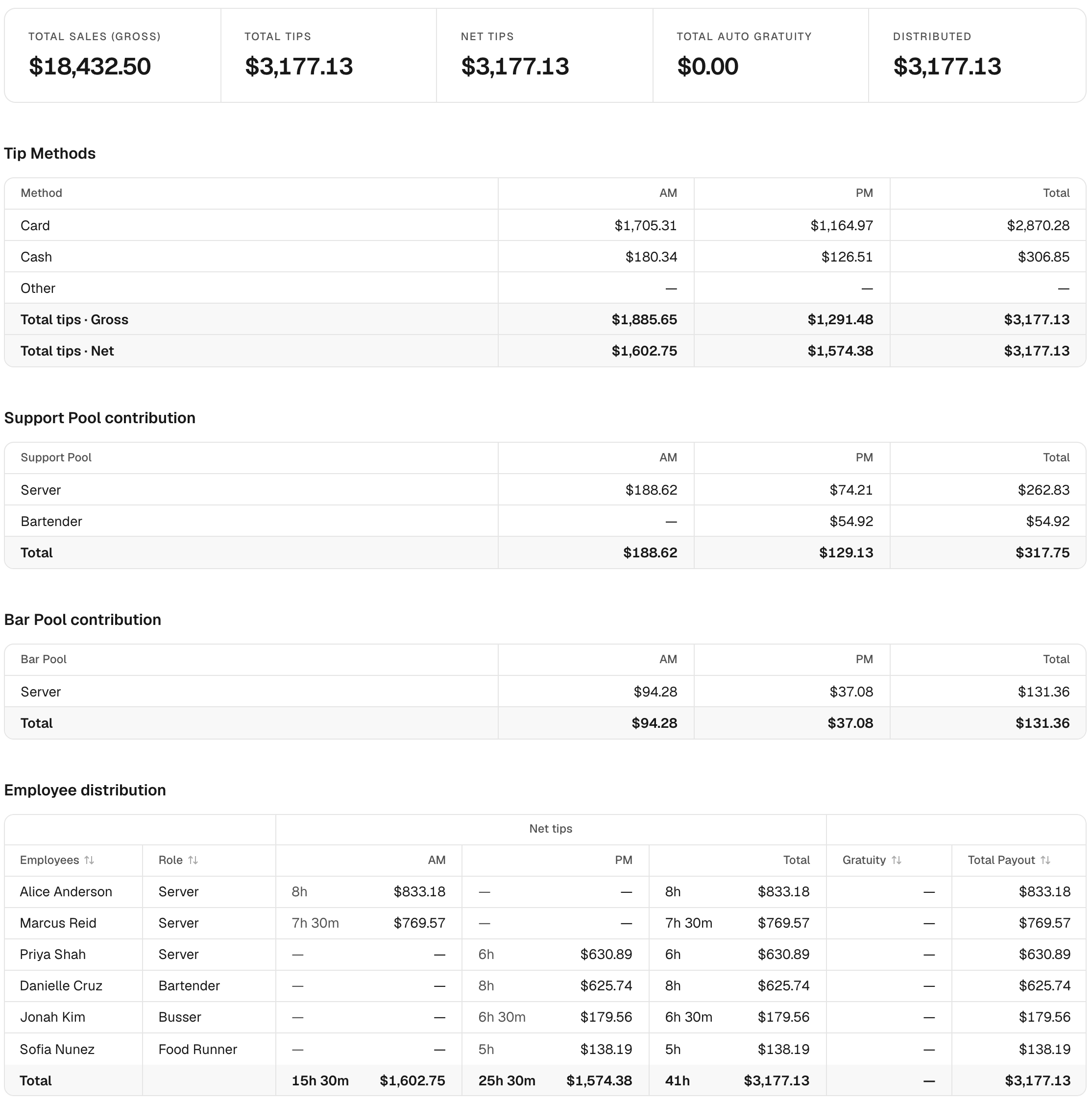
- Total tips and amount distributed
- What each role paid into each pool
- Each person's final payout
In a demo, bring the $600 example or a real shift and ask to see the role change and the corrected record. Treat any exception flow as something to test, not assume. The wider buying criteria are in tip management software for restaurants.
Tip pooling questions
Do tips have to be shared equally in a tip pool?
No. Equal shares are one option, not a requirement. What matters is that the method is written down and applied the same way every period, so a changed share always has a reason someone can point to.
Do cash tips have to go into the tip pool?
That depends on your written policy and the law where you operate. Decide which tips enter the pool (card, cash or both) and record each source on its own line, then confirm the pool total matches what was collected before you split it.
Why do some servers dislike tip pooling?
The usual complaints are that the split ignores workload and that people can't see how their amount was reached. Weights answer the first only when the team agrees on what they reward; the second is a record problem, not a formula problem.
Before changing next week's pool
Change one thing at a time, and run the new setup on paper next to the old one first, so everyone sees who moves and by how much.
- Confirm who is eligible under federal rules and your state's, before setting any weights.
- Pick the formula, then write down the weights and what they reward.
- Pick the pooling window and say why in one sentence.
- Run last week's real numbers through the old and new setups and share the differences.
- Give each person a closeout record and name who handles corrections.
Sources
- [1] U.S. Department of Labor, Fact Sheet #15
- [2] U.S. Department of Labor, Fact Sheet #15
- [3] U.S. Department of Labor, Fact Sheet #15
- [4] U.S. Department of Labor, Fact Sheet #15
- [5] U.S. Department of Labor, Fact Sheet #15
- [6] California Department of Industrial Relations, Labor Commissioner tips and gratuities FAQ
- [7] Texas Workforce Commission, tip pooling guidance
- [8] Reddit r/restaurant comment (February 2026 thread)
- [9] Reddit r/Serverlife thread (worker account, August 2022)
- [10] Reddit r/Serverlife comment (worker account, August 2022)
- [11] Ferry Tip Manager product page (canonical facts register)
- [12] Ferry Tip Manager product page (canonical facts register)